A musical reward must (1) generate anticipation prior to its occurrence, (2) improve the player's emotional state relative to the current musical context, and (3) convey the relative value of different rewards. Musical rewards therefore require the establishment of a musical context with which they may more or less contrast.
[...] This paper proposes a shift in design perspective: game music that traditionally follows the player's progression can instead guide the player by rewarding their actions within a structured network of musical rewards operating across multiple scales.
Vers un Nouveau Design des Récompenses Musicales dans le Jeu Vidéo
Une récompense musicale doit (1) générer de l’anticipation avant son apparition, (2) améliorer l’état émotionnel du joueur par rapport au contexte musical en cours, et (3) transmettre la valeur relative des différentes récompenses. Les récompenses musicales nécessitent donc l’établissement d’un contexte musical avec lequel elles peuvent plus ou moins contraster.
[...] Cet article propose un changement de perspective dans le design : la musique de jeu, qui suit traditionnellement la progression du joueur, peut au contraire la guider en récompensant ses actions au sein d’un réseau structuré de récompenses musicales opérant à plusieurs échelles.
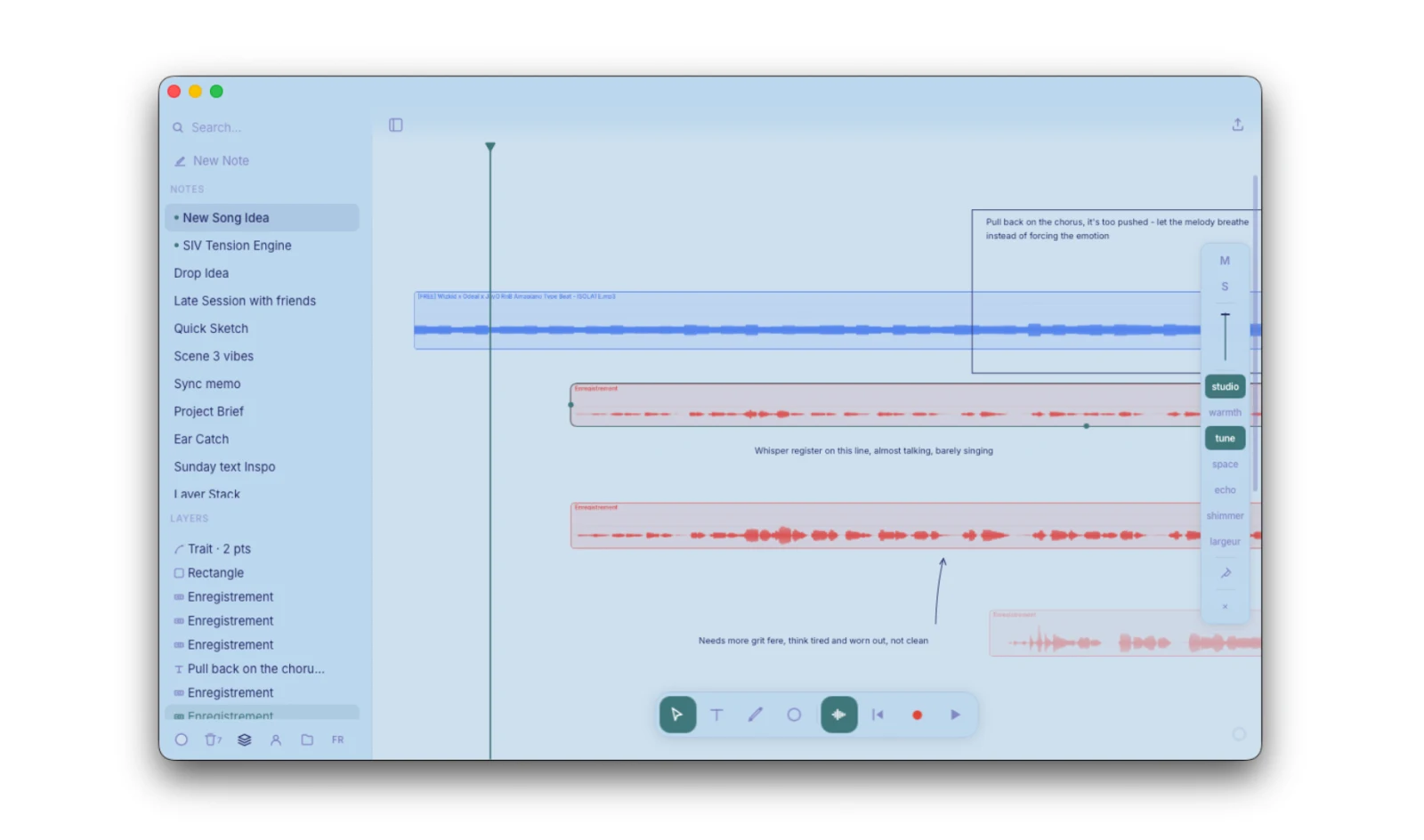
Few Notes, an ergonomic note-taking app designed for songwriters & composers.
Captures musical and vocal ideas alongside written notes, linking the two organically. Local AI features to organize and query your notes. A simple interface with a polished UX that streamlines editing and sharing. Built to handle accumulating notes as structured, searchable text and music data.
Ezéchiel Sene-Boileau
Born in Île-de-France in 2003 into a Franco-Senegalese family, he grew up in Rennes, in an environment shaped by the social sciences, the visual arts, and music. He began studying Mandarin and Chinese culture at age 8, guided by a principle of openness to the world. This heritage informs his interest in cultural circulations and systems of thought rooted in Asian, African, and diasporic worlds.
Trained in graphic design at the École supérieure d'art et design de Valence, he continued his studies at the Campus Caribéen des Arts in Martinique, where his interest in the relationship between musical practices and bodies was born. He then returned to mainland France at the École supérieure d'Art et Design de Saint-Étienne, where he studied live coding and musical modulation under Raphaël Forment and Christophe Lebreton, both creators of musical programming languages. He ultimately earned his Master's degree in digital design there, before pursuing his research at Tongji University in Shanghai, ranked 1st in Asia in the QS Art & Design rankings. There, his thinking took on a solid theoretical structure, drawing on neurological theories of music as well as diverse examples of musical structures from around the world.
His work led to the creation of the Tension Engine, an audio engine that transforms musical structures in real time.
It is built on a central hypothesis: musical practices do not only transmit aesthetic forms, but also ways of organizing attention and individuals' relationship to their environment.
He will have the opportunity to present his work at the Ludomusicology 2026 conference (Edge Hill University), and to continue developing the Tension Engine through interactive installations, video game projects, and international collaborations.